Research Assistance Program Laboratory Inspections
Learn more about EH&S Research Assistance Program laboratory inspections.
Laboratory Inspections – Program Summary
The EH&S Research Assistance Program (RAP) conducts routine laboratory inspections of research labs, research support shops and instructional lab spaces that store and use hazardous materials or involve hazardous operations. The inspection program is designed to help principal investigators (PIs), area managers, supervisors and lab personnel identify issues, reduce risk to people, environment and the campus community, and maintain compliance with applicable regulatory, accreditation, sponsor and university requirements.
Program Goals
- Minimize risks of injury and illness, property and environmental damage
- Verify compliance with University policies and regulatory requirements
- Identify and correct hazardous and noncompliant conditions to minimize risks
- Support implementation of effective hazard controls
- Promote continuous improvement in lab safety.
Integrated Safety Inspections
EH&S performs comprehensive inspections that evaluate multiple safety disciplines through a coordinated review process. Inspection areas include lab safety, chemical safety, biosafety, controlled substances, hazardous waste, fire and life safety, injury and illness prevention, personal protective equipment, emergency preparedness, training and documentation.
Inspection Frequency
Inspection frequency is determined by using a risk-based approach. Most labs and research areas will have routine inspections approximately annually at a minimum. Frequency may increase based on hazard profile, compliance history, regulatory requirements, operational complexity and overall risk.
Inspection Process
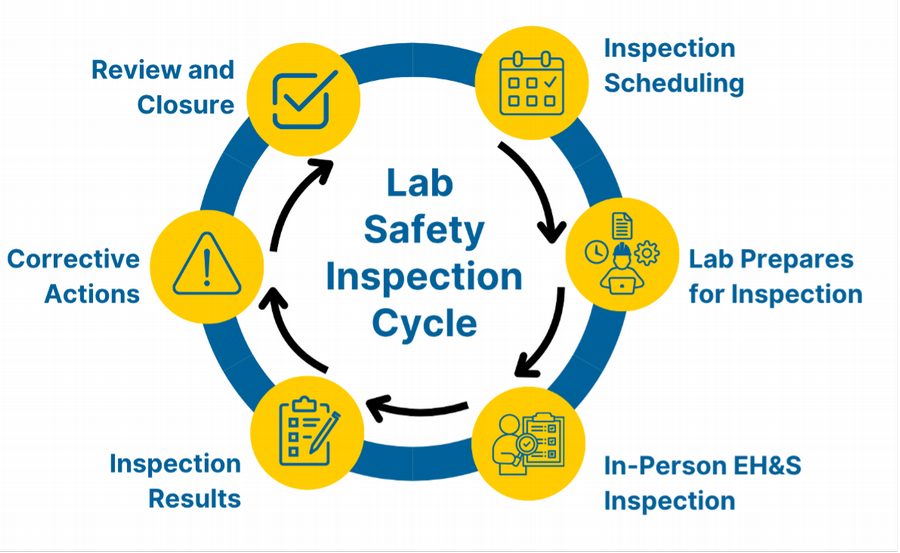
Lab Safety Inspection Cycle
- Inspection Scheduling – The Research Assistance Program conducts pre-scheduled inspections. Note: emergency responses to time sensitive safety concerns or incidents may involve an unannounced inspection.
- Lab Prepares for Inspection – Laboratories review My Research Safety records, training records, previous findings and self-audit documentation.
- In-Person EH&S Inspection – EH&S conducts an administrative review and physical walk through of assigned spaces with laboratory personnel (typically the lab's designated safety contact).
- Inspection Results – Findings are documented and distributed through the EH&S Inspection Tool.
- Corrective Actions – Laboratories submit corrective actions and supporting documentation via the Inspection Tool to resolve findings.
- Review and Closure – Findings are reviewed and either accepted or returned for clarification until closure is achieved. Final resolution occurs when all findings are closed.
Inspection Criteria
Criteria used to evaluate laboratories has been developed by UC San Diego EH&S to meet local, state and federal code requirements, as well as University of California Office of the President and local campus policies.
- Administrative Requirements
- Biological Safety
- Chemical Safety
- Controlled Substances
- Fire and Life Safety
- Hazardous Waste
- Lab Design
- Physical Safety
- Safety Equipment
- Work Practices
Download a printable checklist (Excel)
Resolution Timelines
High-risk findings: Resolution required within two business days.
Medium-risk findings: Resolution required within 10 business days.
Low-risk findings: Resolution required within 10 business days.
A corrective action plan may be accepted as a resolution when procurement, facilities work, significant coordination or other extended implementation timelines are necessary. High-risk finding corrective action plans need to be implemented with higher priority and urgency.
Resolution Escalation Framework
A progressive escalation process promotes timely resolution of findings. The campus Laboratory and Chemical Safety Committee has established this framework.
Step 1 – Inspection Report Issued
Results and findings are communicated through the EH&S Inspection Tool. Corrective actions and supporting documentation must be submitted within the Inspection Tool by the required due date(s).
Step 2 – Automated Reminders
Automated reminder notifications are issued prior to and after corrective action due dates as necessary. Notifications are sent to the responsible party, area safety contact(s) and department safety officials.
Step 3 – Department Leadership Notification
If findings remain unresolved after multiple reminder notifications and approximately 20 business days, department leadership may be included in future communications to assist with resolution.
Step 4 – Enhanced Oversight
Repeated non-response, recurring deficiencies or significant unresolved findings result in a review by the Laboratory and Chemical Safety Committee. The committee will determine required measures of resolution along with future prevention actions, such as increased inspection frequency, self-assessments, meetings with department leadership and additional safety training.
Step 5 – Significant Risk Conditions and Enforcement Authority
Laboratory Self-Audits
Labs are expected to conduct routine self-audits between the scheduled EH&S inspections. Self-audits help laboratory personnel identify hazards, reinforce safe work practices and address issues before they become significant compliance concerns. Completed self-audit records should be maintained and made available upon request. Lab Self-Audit Form
Inspection Tool Resources
Users may access the EH&S Inspection Tool through My Research Safety to review inspection reports, view findings and photographs, submit corrective actions, track inspection status and access historical inspection records. Contact your RAP team member for additional resources on navigating the Inspection Tool, including how-to guides for submitting corrective actions.
References
Inspection criteria are based on applicable requirements, including Cal/OSHA standards, California hazardous waste regulations, NFPA standards, applicable building and fire codes, NIH guidelines, CDC biosafety guidance, and UC San Diego policies and procedures.
Questions? Contact the EH&S Research Assistance Program.