Research Misconduct FAQ
Last Updated: July 15, 2026 3:21:49 PM PDT
Give feedback
Expand section
What is Research Misconduct?
Research Misconduct is defined by federal law and University policy as fabrication, falsification, or plagiarism in proposing, performing, or reviewing research, or in reporting research results.
- Fabrication is making up data or results and recording or reporting them.
- Falsification is manipulating research materials, equipment, or processes, or changing or omitting data or results such that the research is not accurately represented in the research records.
- Plagiarism is the appropriation of another person’s ideas, processes, results, or words without giving appropriate credit.
If you suspect that Research Misconduct has occurred, contact Corinne Peek-Asa, Vice Chancellor for Research and Innovation (VCRI) and Research Integrity Officer (RIO), at (858) 534-3526 or researchintegrity@ucsd.edu to submit an oral or written complaint.
Research Misconduct (as defined by federal law) does not include disputes about authorship or attribution of credit, confidentiality, access to data, honest error or differences of opinion. Questionable or improper practices that are not defined as Research Misconduct may be considered misconduct under other University policies including, but not limited to, conflict of interest, intellectual property, biosafety, use of human and animal subjects, financial management, use of University facilities, outside professional activities, employee relations and faculty-student relations.
For disputes related to research that do not involve Research Misconduct, please contact the appropriate research group, center or department and/or Department Head.
Who are the key players?
- Complainant
A person who makes an allegation of Research Misconduct - Deciding Official
The Deciding Official makes the final determinations on Allegations of Research Misconduct and any actions. At UCSD the Vice Chancellor for Research and Innovation is the Deciding Official - Research Integrity Officer (RIO)
The RIO is responsible for administering the Policy and procedures for addressing allegations of Research Misconduct. The Vice Chancellor for Research and Innovation appoints the RIO. - Respondent
A person who is the subject of an allegation of Research Misconduct - Standing Inquiry Committee for Integrity of Research
The Standing Committee consists of a pool of faculty selected for disciplinary breadth in consultation with the Academic Senate. Committee members will serve on the Inquiry Committee and/or the Investigation Committee, as assigned. Members of each Committee are guided by Policy on Research Misconduct (Fabrication, Falsification, and Plagiarism) and University Guidelines for Conducting an inquiry and/or an investigation. - Witness
Any person(s) pertinent to the Research Misconduct inquiry or investigation
All of those involved in Research Misconduct review, especially committee members, must ensure confidentiality regarding the people and incidents related to the cases.
What is the difference between a “Complainant” and a “Respondent”?
A “Complainant” is a person who makes an allegation of Research Misconduct. A “Respondent” is a person against whom an allegation of Research Misconduct is directed or who is the subject of a Research Misconduct proceeding. Both the Complainant and the Respondent are responsible for maintaining confidentiality and cooperating with the conduct of an inquiry and investigation.
What is the process for reviewing a Research Misconduct complaint?
The Research Integrity Officer (RIO) is the individual responsible for oversight of Research Misconduct at UC San Diego.
The first stage in reviewing a complaint of Research Misconduct is a preliminary assessment to determine whether the complaint falls within the definition of Research Misconduct and if so, whether there is sufficient evidence to warrant an inquiry. The allegation must be credible and specific so that evidence of the Research Misconduct can be identified.
If the RIO determines that an inquiry is warranted, the RIO and at least one academic scholar from the Standing Committee will review the evidence. If the Committee concludes that there is probable cause that Research Misconduct may have occurred, an investigation will be initiated.
During an investigation, a panel of three or more academic scholars from the Standing Committee will review the evidence in depth and interview relevant witnesses. At the conclusion of the investigation, the panel will make a recommendation regarding whether, by a preponderance of the evidence, the respondent engaged in Research Misconduct and, if so, whether the respondent acted intentionally, knowingly or recklessly. In order for there to be a finding of Research Misconduct, there must be:
- A significant departure from accepted practices of the relevant research community, and
- The misconduct be committed intentionally, knowingly, or recklessly, and
- The allegation be proven by a preponderance of the evidence.
Possible Paths for Research Misconduct Review
Research Misconduct reviews can follow any of these paths:
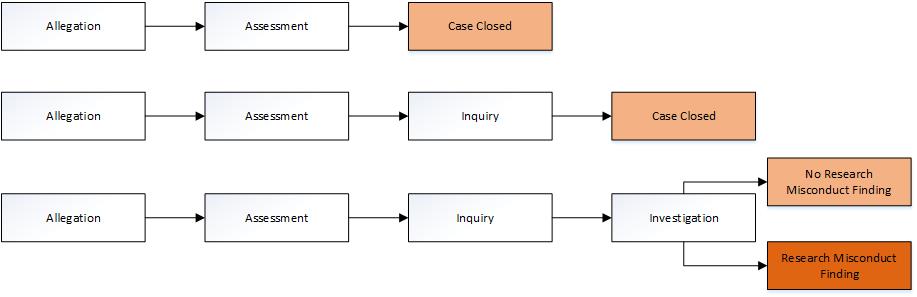
Policy on Research Misconduct (Fabrication, Falsification, and Plagiarism).
What are my rights if I am accused of Research Misconduct?
Information about confidentiality of the proceedings in a Research Misconduct case and other precautions to protect the rights of both the respondent and the complainant are included in the Policy on Research Misconduct (Fabrication, Falsification, and Plagiarism) The rights of the respondent include the opportunity to testify, to be accompanied by an advisor during any interview (for the purposes of observation and advice) and if an allegation lacks substance or if there is no finding of Research Misconduct, reasonable and practical efforts will be made by the RIO to protect or restore the respondent’s reputation.
How can I help to prevent Research Misconduct?
Research Misconduct investigations are difficult for everyone involved, particularly the respondent. The following are some strategies researchers can employ to avoid being the subject of an allegation of Research Misconduct:
- Monitor the research in which you are involved. Inform your staff, students and collaborators that you will verify data collection, entry and reporting. Ask questions about questionable results.
- Set reasonable expectations about the time it will take to collect the necessary data.
- Always maintain thorough and complete research records.
- Do not deviate from the protocol without obtaining the necessary approvals, for example, from the IRB, IACUC, etc.
- Communicate with the Principal Investigator and members of the research team any actual or perceived problems with the research.
- Carefully and accurately report the research. Be specific about methods and procedures used and the data obtained.
- Thoroughly review all papers where you are listed as an author.
- Do not give or agree to honorary author status. This is inconsistent with the guidelines provided by Health & Human Services Office of Research Integrity.
- Promote research integrity in your courses and labs. Encourage attendance and completion of the Responsible Conduct of Research programs.
How do I report suspected Research Misconduct?
If you suspect that Research Misconduct has occurred, submit a Research Misconduct Allegation Intake Form to initiate the reporting process.
If you are unsure whether a suspected incident falls within the definition of Research Misconduct, you may consult with the Research Integrity Officer (RIO) to discuss the incident informally, which may include discussing it anonymously and/or hypothetically.
You can contact the RIO at researchintegrity@ucsd.edu.
What resources are available if I’m involved in a Research Misconduct action?
For members of the research community involved in a Research Misconduct action, UC San Diego provides support and assistance in finding a solution. Refer to the Research Misconduct Resources Factsheet for information regarding resources.
For more information, contact the Office of Research Compliance and Integrity at (858) 822-4939 or email researchintegrity@ucsd.edu