How to Close or Relocate a Laboratory
Learn how to close a lab and relocate a lab.
Notify Environment, Health & Safety (EH&S)
Notify EH&S of your intended move or lab closure 30 days prior to your moving day.
- Use the online Laboratory Relocation or Closure Notification form.
Important: Timely submittal of the form allows an update of records required by granting and regulatory agencies, and will permit continued use of regulated materials, such as radioisotopes, without interruption.
*See UC San Diego lab opening and close-out policy for details.
Insurance coverage
Insurance is required if UC San Diego Moving Services or an outside moving vendor is used.
Make sure you have adequate insurance coverage:
- Make an inventory list of all items to be moved and their values.
- Contact Risk Management, (858) 534-3820, to make sure your inventoried items are appropriately valued and adequately insured.
- Read Does Your Department Have Adequate Insurance Coverage? for more information.
Animal relocation and imports
The Animal Care Program requires information in advance about animals to be imported from other research institutions to ensure adherence to UC San Diego animal health and regulatory requirements. Advanced planning is essential to ensure adequate space and equipment are available for the animals once they arrive.
Most animals, especially rodents, imported into UC San Diego require a quarantine period or rederivation prior to entering a vivarium.
Arrange animal relocation and imports through the Animal Care Program:
- Contact the Animal Care Program, (858) 534-4262, to arrange an operational meeting to discuss your research needs before beginning a move at or to UC San Diego.
- Read about the animal acquisitions process on the Animal Care Program Web site.
- For assistance with animal moves and imports, contact the Animal Transfer Coordinator, (858) 822-0083.
Controlled substances
Controlled substances (CS) cannot be removed, transferred, or shipped from campus.
- If the PI is relocating a lab on campus, contact the CS Program Manager, (858) 534-1362, to have your new storage locations approved prior to moving.
Note: CS may be stored at a secure EH&S facility during your move. - If the lab is closing or moving off campus, contact the CS Program Manager, (858) 534-1362, to arrange return of unused CS and log sheets to EH&S. The PI will need to submit a CSUA Deactivation form as well to formally close out the CSUA.
Chemical, radioactive, and biohazard inventory
Follow specific steps below for transferring, shipping, or disposing of research materials:
- Chemicals – Transfer usable surplus chemicals to new owners or donate them to Chemcycle.
- Radioactive materials – Read How to Transfer Radioactive Materials before transferring or moving radioactive materials.
- Biohazardous materials – Dispose of biohazard waste, including sharps, according to the proper procedure for your building. Check with your lab manager for instructions.
- Shipping – Read How to Ship Hazardous Materials if you will be sending any of the following materials off campus to a new destination:
- Hazardous materials
- Radioactive materials
- Diagnostic specimens
- Infectious substances
- Hazardous waste – Request a hazardous waste collection for hazardous chemical and radioactive materials that can no longer be used.
Also, see Transporting Hazardous Materials for Inter- and Intra Campus.
If you need help, contact an EH&S Research Assistance Program specialist.
Decontamination and housekeeping
Decontaminate, clean, and empty the lab space before requesting an EH&S final clearance. Help Facilities Management, contractors, your department, and EH&S stay on schedule by addressing possible contamination issues well in advance of your actual departure date.
Follow specific instructions for hazardous materials below:
Chemical contamination
- Contact your EH&S Research Assistance Program specialist if there are any special circumstances or challenges regarding hazardous chemical usage that could make the clearance process more difficult.
- If perchloric acid has been used in the chemical fume hood, notify the EH&S Research Assistance Program specialist for your building.
- Remove benchcoat, disposable liners, and covers from work surfaces and fume hoods.
- Cut any visible contamination (i.e., stains) from disposable material and bag it separately for hazardous waste disposal.
- Discard the remaining uncontaminated material in the regular trash.
- Decontaminate thoroughly any visible chemical contamination.
- Request an EH&S Decontamination Clearance for equipment or facilities that may have come in contact with hazardous chemicals.
Biohazard contamination
- Disinfect all work surfaces and biosafety cabinets.
- Contact your EH&S Research Assistance Program specialist if you have questions regarding decontamination.
- Request an EH&S Decontamination Clearance for equipment or facilities that may have come in contact with biohazardous materials.
Radioactive contamination
- Perform a meter survey and wipe test of work surfaces and equipment to confirm decontamination.
- Use the Laboratory Survey Sheet to document the results.
- Place a copy of the completed survey in the laboratory survey book.
- If non-removable contamination is found, contact EH&S Radiation Safety, (858) 822-2494.
- Request an EH&S Decontamination Clearance for equipment or facilities that may have come in contact with radioactive materials.
General housekeeping
- Follow instructions for properly defrosting a research freezer (PDF), if applicable.
- Wash lab benchtops, equipment, and fume hoods with soap and water.
- After the lab is empty and clean, run water into sinks and floor drains to fill traps.
- Request hazardous waste pick up for hazardous materials, refrigerators, and freezers.
- Request an EH&S Decontamination Clearance before disposing of or sending equipment to Surplus Sales.
Important: Never abandon unwanted or damaged equipment or hazardous materials in the lab or hallways.
If you need help, contact an EH&S Research Assistance Program specialist.
Final clearance
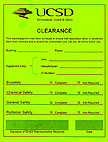 Request final clearance:
- Contact the EH&S Research Assistance Program specialist for your building to schedule a clearance survey.
- EH&S will post a green clearance tag on the door (see image at right) when the facility is cleared of hazards.